

CEO's Message
DEAR SHAREHOLDERS,
We made meaningful progress in our core operations in FY26. On the back of robust construction activity in Singapore, we delivered an improved financial performance and strengthened our operational capabilities, while maintaining our longstanding discipline on project selection and cost management. Throughout the year, we were focused on executing projects well and protecting our margins, while continuously investing in our people and equipment, in order to position CSC for the long term.
FINANCIAL REVIEW
Our performance in FY26 reflects the benefits of our disciplined approach. Revenue rose 18.5% to $400.4 million, from $337.8 million in FY25, supported by a higher volume of foundation and geotechnical engineering works undertaken in Singapore.
Gross profit increased 9.0% to $38.6 million, compared to $35.4 million in FY25, while gross margin stood at 9.6%, compared to 10.5% in the preceding financial year. While margins in Singapore improved, our overall margins were affected by the recognition of certain lower-margin projects in Malaysia, the financial impact of which has been fully captured in FY26. We also experienced higher energy and raw material costs in the final quarter of FY26, arising from geopolitical developments.
Other income amounted to $1.2 million, compared to $2.3 million in FY25. The decrease was largely due to lower gains from the disposal of aged equipment. These disposals form part of our ongoing fleet renewal programme, through which older equipment is progressively replaced with newer and more efficient models.
Operating expenses increased by 7.2% to $31.4 million, from $29.3 million, broadly in line with higher levels of business activity. At the same time, we continued to exercise cost discipline across the Group and maintained a lean operating structure.
Net finance expenses declined 8.7% to $6.0 million, from $6.6 million a year ago. This was achieved through a combination of lower floating interest rates and our continued use of our multi-series unsecured commercial paper facility programme (SDAX CP Facility Programme) to progressively replace higher-cost borrowings and optimise financing costs. Included within net finance expenses for FY26 is a lease liability of $1.0 million, compared to $1.1 million in FY25, that is related to our Group's leased headquarters premise.
Our share of profit from associates of $0.9 million was stable year-on-year, comprising contributions from our associates, partially offset by revaluation losses on an investment property held by an associate.
As a result, earnings before interest, tax, depreciation and amortisation (EBITDA) rose 3.0% to $32.3 million, from $31.4 million in the preceding financial year, demonstrating the strength of our underlying operations and cash earnings. Net profit attributable to shareholders thus grew 42.9% to $2.7 million for FY26, from $1.9 million in FY25, with basic earnings per share improving to 0.08 cents, from 0.05 cents.
Our Group's total assets stood at $394.2 million as at 31 March 2026, compared to $396.3 million as at 31 March 2025. The net book value of property, plant and equipment was S$117.8 million, compared to $115.8 million as at 31 March 2025. This took into account capital expenditure of $17.1 million as part of the ongoing fleet renewal programme and the reclassification of $2.4 million of inventories, partially offset by depreciation of $17.6 million and disposals of plant and equipment with carrying value of $0.7 million. During the year, our Group conducted an operational efficiency review of our plant and machinery, which resulted in a revision to the expected useful lives of certain equipment from 15 years to 10 years. This is in line with our intention to maintain a younger and more productive fleet.
Cash and cash equivalents rose to $22.0 million as at 31 March 2026, compared to $19.1 million a year ago. Cash flow generation from our operating activities improved significantly year-on-year, as a result of focused working capital management and efforts to expedite collections of trade receivables.
Net current liabilities stood at $6.8 million as at 31 March 2026, compared to $2.2 million as at 31 March 2025. This factored in the higher capital expenditure and inherent timing of cash flows in our business, even as we continue to engage closely with clients on receivables management and prioritise working capital efficiency. Committed unutilised credit facilities have increased to $54 million as at 31 March 2026, compared to $29 million available at 31 March 2025, reflecting the strength of our banking relationships.
Loans and borrowings stood at $94.8 million as at 31 March 2026, compared to $101.7 million as at 31 March 2025, with the Group's gearing ratio improving to 0.87 times, from 0.95 times as at 31 March 2025. The proportion of floating rate borrowings decreased to 52%, as a result of our efforts to move towards more stable, longer-tenure loans. During FY26, we also issued $47.9 million in commercial papers under the SDAX CP Facility Programme, of which $43.1 million matured and were fully redeemed. As at 31 March 2026, outstanding commercial papers amounted to $17.5 million, bearing interests rates of 4.1% to 4.6% per annum. This is a meaningful reduction from the 5.2% to 5.6% range as at 31 March 2025.
As at 31 March 2026, we held 110.3 million shares with carrying values of $3.5 million as treasury shares, following the repurchase of 16.2 million ordinary shares during the year for a total consideration of $0.2 million.
OPERATIONS REVIEW
Our foundation and geotechnical engineering business was the primary driver of Group performance in FY26, with segment profit more than doubling year-on-year on the back of a 20% increase in revenue. The improvement reflects stronger market demand, higher project margins in Singapore and the operational benefits of a right-sized fleet, which gave us the confidence to be selective in our tendering and focusing on work that met our margin requirements rather than pursuing volume for its own sake.
During FY26, we secured and executed a broad range of projects spanning transport infrastructure, public housing, data centres, semiconductor facilities, pharmaceutical developments, industrial projects and commercial developments. These projects require specialised engineering capabilities and stringent safety and execution standards, particularly in densely built-up environments where vibration control, noise management and operational reliability are critical. Some of the foundation and geotechnical engineering projects we have secured include:
Infrastructure
- Core and shell works for the Changi Airport Terminal 2 Connection (T2C), and the construction of airfield facilities
- Influent pumping stations for PUB's Tuas Water Reclamation Plant (Contract C2A)
- Land Transport Authority multi-storey bus depot at Simpang, Yishun
- Drainage improvement projects for PUB at Indus Road and Makeway Avenue
Residential
- Public housing developments at Sembawang Drive (Project CQ), Chai Chee Street (Project ER), Geylang (Project C55), Simei Road (Project FH) and Admiralty Lane (Project CL)
- Faber Residence at Faber Walk
- Lucerne Grand at Lakeside Drive
- Narra Residences at Dairy Farm Walk
- River Modern at River Valley Green
- Vela Bay at Bayshore Walk
- Aurum Service Apartment at Bandar Sunway, Selangor, Malaysia
Industrial
- Additions and alterations to ExxonMobil refinery at 18 Pioneer Road
- WuXi STA's H92 waste-water treatment plant at Tuas Avenue 5
- Six-storey single-user self-storage warehouse at Kaki Bukit Avenue 5
- GE Aerospace's aerospace component manufacturing plant at Seletar Aerospace Link
- Air Liquide Global Solutions bulk gas plant at Tampines Industrial Avenue 1 for gas supply to VisionPower Semiconductor Manufacturing Company nearby
- Sunview Logistics & Container Hub, a six-storey ramp-up warehouse and two-storey container depot at Sunview Road
- AstraZeneca's biopharmaceutical facility at Tuas South Avenue 5 and 14
- Nine-storey single-user industrial development at Kaki Bukit Avenue 5
- Changi Airport Group's new private terminal at the former Commercially Important Persons Terminal at Changi Airport Terminal 2
- Major hyperscale data centre at Cyberjaya, Malaysia
Commercial
- Porsche Experience Centre Singapore at Aviation Park Road
- Reconstruction of Tanjong Katong Complex at 845 Geylang Road
- Mixed development at Kampung Kerinchi, Kuala Lumpur, Malaysia
Institutional
- Bethesda Community Church at Tampines Street 86
- High Commission of India at 54 Stevens Road
- Multi-storey vehicle storage building and ancillary facilities for Pasir Laba Camp and Kranji Camp
- Phase 2A additions and alteration works involving lift installation and ancillary works for Ministry of Education schools
- Phase 2 construction of Singapore American School's seven-storey middle school at 40 Woodlands Street 41
- Additions and alteration works for existing facilities at the Defence Science and Technology Agency (DSTA) at Lim Chu Kang
- Specialist Hospital at Seremban 2, Negeri Sembilan, Malaysia
- Garden International School at Jalan Kiara 3, Kuala Lumpur, Malaysia
As part of the Group continued fleet renewal plan, while maintaining the overall size of the fleet, we have also been investing in newer and more efficient equipment to improve asset productivity and utilisation rates. Going forward, we will maintain fleet investment at a one-for- one replacement basis, which will enable us to sustain operational capacity without expanding fixed costs.
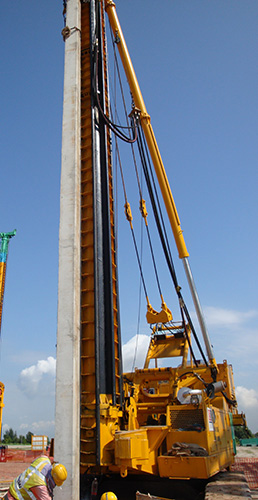
To reduce fuel consumption and improve operational efficiency, we have been evaluating and deploying hybrid piling equipment. Following trials that demonstrated conventional electric vehicles to be operationally impractical for heavy piling applications, we identified hybrid powerpack technology as a viable and cost- effective alternative. Two hybrid machines have been deployed for jack-in piling operations, with two further machines for bored piling expected to be added to the fleet. Estimated fuel savings from the hybrid configuration range from 30% to 50%, which support our efforts to manage the impact of diesel price volatility on operating margins.
Our equipment sales and leasing business registered revenue growth across all key markets, including Singapore, Malaysia, India, Thailand and Vietnam. In particular, Vietnam delivered a marked increase from a low base, mainly due to rising construction activity and the Group's expanding business relationships there.
We have established a new service centre operation under our 55%-owned subsidiary, THL Foundation Equipment Pte. Ltd. The service centre has commenced operations in March 2026, with capabilities in repair, servicing and parts supply for major foundation equipment. It should fill the gap for such services in Singapore, as the deployment of Chinese equipment has grown alongside the increased participation of Chinese contractors in local construction projects. It also supports our own fleet maintenance efficiency.
OUTLOOK AND PROSPECTS
Against the broader construction demand backdrop, our pipeline of project opportunities is active across both public and private sectors. We are participating in tender processes for upcoming HDB residential packages, rail-related civil works including those associated with the Circle Line extension, and a range of institutional and infrastructure projects expected to be progressively tendered out through FY2027. The progressive award of these contracts, as tender exercises are concluded, will determine the pace of order book replenishment.
On the private sector side, we are seeing a growing flow of opportunities in pharmaceutical and biomedical construction, semiconductor facilities, and aerospace- related industrial development. These projects typically require the kind of safety management capability that CSC has developed over decades, and command higher margins. We intend to pursue this pipeline with the same selectivity and discipline.
The healthy construction demand environment is also expected to sustain demand for the foundation equipment distributed by the Group's trading division and for the repair and servicing capabilities of our THL service centre. The front-loaded establishment costs were absorbed in FY26; as the service revenue base develops, we expect the division to contribute positively to segment performance as it ramps up toward full operational capacity in FY27.
In Malaysia, the pipeline of bored piling projects deferred from FY26 is expected to commence in FY27 and contribute to the segment's revenue recognition in that year. Combined with the normalisation of operations following the completion of the project that affected margins in FY26, we expect the Malaysian segment to return to a positive contribution in FY27. We will pursue opportunities in this market selectively, focusing on higher-specification work in data centre, healthcare, and institutional construction where our capabilities are most relevant and margins are more defensible.
Our order book stood at approximately S$220 million as at 30 April 2026, compared to S$270 million as at 31 October 2025. This took into account the completion of several projects during FY26 and our prudent approach towards order book replenishment.
We remain mindful of cost pressures across the industry, including tight labour market conditions and volatility in diesel and construction material prices. With an average project turnaround of three to six months for foundation works, among the shortest cycles in the construction value chain, we have the flexibility to factor in prevailing cost conditions into new tender pricing more quickly than contractors engaged in works with longer duration. This provides us with a hedge against volatility in input costs. The Government's cost-sharing arrangements provide some additional near-term relief for a portion of our existing order book as well.
APPRECIATION
The results presented here were delivered through the sustained efforts of our people on project sites and in supporting functions across Singapore, Malaysia, and the region. I acknowledge the contribution of every member of our workforce. In a year that demanded great effort from them operationally, their commitment is what made the progress we have made possible.
I also thank our customers for their trust in the Group's capabilities, and our business partners for their continued support. I am grateful to our Board of Directors for their guidance and counsel. Lastly, thank you to all our shareholders for standing by us.
I am confident in our Group's direction and look forward to the journey.